Affiliate disclosure: Some links in this post are affiliate links, which means I may earn a small commission if you purchase through them, at no additional cost to you.
Someone who was raised and educated in a non-Chinese-speaking country and acquired Mandarin Chinese informally through speaking with family and friends is known as a heritage speaker (the linguistic term) or a member of the diaspora community (the social term). Some heritage speakers would have attended formal lessons to learn to read and write.
“I speak Mandarin with my family, but how can I learn to read?” “I can read some Chinese characters, how can I learn more?” and “I used to be fluent in Chinese, but I’ve forgotten it. How can I regain this and learn to read?” are common questions asked by many people of Chinese heritage around the world.
Technology and the internet have changed our world in unimaginable ways and have affected how we learn languages. With access to millions of hours of content from all over the world, learning and improving a language couldn’t be easier, especially if you already have some experience with Chinese.
I’m a heritage speaker from a Cantonese-speaking background. I’ve been learning Mandarin Chinese for over five years. In this post, I will show you ways you, as someone with a background in Mandarin, can quickly and easily improve your reading abilities!
Don’t compare yourself
Before we discuss this topic further, you must first remember never to compare yourself to native or other heritage speakers.
Don’t feel ashamed or embarrassed about your proficiency in Mandarin Chinese; you grew up in a place where Chinese is not the primary language in your everyday life. It’s normal that you’re not very good at it!
Your entire education was in another language, so it can’t be compared to someone educated in a Chinese-speaking country. Every heritage speaker is in the same boat as you, and you are not alone!
Your Experience
A heritage speaker’s level of Mandarin Chinese can vary widely, as this hugely depends on background and experience, so it’s difficult to write a guide that caters to all levels.
Therefore, this post is for you if you have some prior experience:
- basic knowledge of radicals and components
- able to recognise some Chinese characters
- some knowledge of pinyin or zhuyin
- basic listening and communication skills
If you have little to no experience and need to start from the beginning, refer to my guide for beginners.
Dictionary Setup
Before you begin your journey, you must download a Chinese dictionary app. Pleco is currently the best app on the market for Chinese learners. This will be your companion for many, many years.
Pleco is a mobile app that offers many free Chinese dictionaries, including one with English definitions of over 100,000 terms. For an additional cost, it offers some extra features, such as a document reader and human audio recordings.
I highly recommend purchasing the basic bundle, which includes a flashcard system, document reader, advanced OCR, additional dictionaries and human audio recordings. One of the additional dictionaries is a more comprehensive English-Chinese dictionary, which is very helpful when trying to fill in gaps in conversations.
There is no need for a paper dictionary as a digital one is far more convenient.
Build Vocabulary and Confidence
Consuming visual and audio content is the best way for you, as a heritage speaker, to build confidence and quickly improve your passive vocabulary!
“Passive vocabulary” are words you can comprehend when you hear or see them, but cannot recall them in conversations or when writing. Don’t worry; having a large pool of passive vocabulary and a smaller pool of active vocabulary in your arsenal is normal. This is also true for all native speakers of any language.
Building your pool of passive vocabulary before starting your reading journey will make the process much easier.
Consume lots of visual and audio content
It may seem counterintuitive and strange that I’m suggesting you consume visual and audio content in a post about improving reading skills, but hear me out. When you learn a new word, you need to learn three parts: the pronunciation, the definition, and the written form.
By consuming visual and audio content, you will learn the pronunciation and definition of new words you encounter. It may not be obvious you’ve learned them, but they are somewhere in your passive memory.
Once these words are in your passive memory, you will only need to learn the written form in order to read. And you can learn the written form once you start reading. Believe me, it’s much easier on your brain when you learn them separately.
Setting up an immersion tool for visual content
You won’t know every single word that you encounter, so you can set up a tool that helps you instantly look up words on video content.
Lexirise is a brilliant free browser extension that integrates with YouTube, Netflix and iQiyi videos, allowing you to look up unfamiliar words and save them for later review.
Additionally, it’s also integrated with many manhua (漫画 – Chinese comics) platforms to provide their pop-up dictionary feature using OCR.
It’s free to use, so it’s worth checking out. They also offer more features with a monthly/yearly subscription or a lifetime purchase of the service. Using my Lexirise link, you’ll receive a 20% discount.
Comprehensive input content
Comprehensive Input (CI) is a popular second-language learning method in which you consume content slightly beyond your level, where you understand ~95% of it.
There are plenty of YouTube channels and podcasts that focus on providing simple, clear, and slow input material for learners.
If your vocabulary and listening aren’t quite up to speed to jump into native content, then material for learners is a brilliant stepping stone.
Here are some popular comprehensive input channels:
- Lazy Chinese – Comprehensible Input (YouTube)
- Jun – StickyNote Chinese (YouTube)
- Chloe Chinese Class (YouTube)
- JiayouChinese (YouTube)
- Chinese Mandarin Cherry (YouTube)
- Xiaogua Chinese (YouTube)
- Slow & Clear Chinese (YouTube)
- Maomi Chinese (Podcast)
TV Shows, Variety Shows, Movies and more
TV dramas, variety shows, and movies are the most accessible visual media for those who don’t live in a Chinese-speaking region.
Many dramas, variety shows, and movies have been made available to international audiences via popular streaming platforms such as Netflix, YouTube, and Viki. In recent years, Chinese streaming services have released easy-to-access platforms for overseas users to access Chinese media. Additionally, their subscription fees are a fraction of the price of other services.

If you are already watching Chinese TV shows with English subtitles, then that’s brilliant. But step up the game: turn off the English subtitles and turn on the Chinese subtitles instead.
But I don’t understand everything they’re saying! Don’t worry; with practice, you will improve by leaps and bounds in no time!
Here are steps you can take to start improving right now:
- Begin by watching low-plot TV shows with common everyday language that contain subjects you’re familiar with.
- You can find suggestions on the TV Drama page and my Notion media bank (look for those with the Newcomer and Intermediate tag)
- My favourite modern show, perfect for learners at all levels, is 《去有风的地方》.
- Try your best to watch and understand using only Chinese subtitles and visuals. You will be surprised at how much you can guess.
- When you struggle to keep up and feel lost, look up unfamiliar words (e.g., using Lexirise, Google Lens, or Pleco) or rewatch segments with English subtitles.
- Have fun and enjoy the content. Don’t worry about understanding every dialogue; you’ll improve as long as you can understand enough to enjoy the show!
- After consuming 100 hours of content, go back and rewatch segments of previous shows. You’ll be amazed at how much you can now understand!
Note: The visual and storytelling aspects of TV shows and movies are important as they help you comprehend and guess unknown words, greatly reducing dictionary lookups while improving your enjoyment. Therefore, in the beginning, avoid content where the visuals aren’t representative of the dialogue, such as talk shows and stand-up comedies.
Audio dramas
Feeling more confident and brave? You can step up your game using audio dramas!
Audio dramas are essentially dramas with only audio — imagine a TV show without the visuals and with added sound effects to represent the scenes. There are no visuals to help with comprehension, just audio and Chinese subtitles.
Without the visual help, you will be forced to focus on the audio and the Chinese subtitles. If you’re able to pick up some Chinese characters, that’s really good; if not, don’t sweat it.
Sadly, these are not available on overseas platforms, so you’ll need to dive into using native Chinese apps and websites.
I recommend 猫耳FM, 漫播 and 饭角. Chinese subtitles are available on these platforms, so listen to them with Chinese subtitles on.
Is this type of media too difficult? No worries, you can stick with visual content, and you’ll improve just fine!
Note: For now, I don’t recommend audiobooks. Unlike dialogue-only content, literature contains many words and expressions that aren’t used in everyday language. You will be overwhelmed by the number of unknown words, which will greatly reduce your comprehension and enjoyment.
When to start reading?
You can start reading whenever you want, but I suggest consuming at least 200 hours of audio and visual content before starting. 200 hours is equivalent to approximately 6-7 full-length dramas.
Acquiring a language comes from engaging with the language in multiple ways, so make consuming a variety of media a part of your everyday life, and your vocabulary pool will grow faster than you can imagine.
Getting Ready to Read
Before you dive into that book you’ve been meaning to read for years, a little preparation can make all the difference. There are study methods and tools you need to be aware of.
A method to memorise words
An effective way to memorise information, in this case, new words, is to use the spaced repetition system.
What is the “spaced repetition system”? In short, it means spacing out your learning with increasing intervals between study sessions; this YouTube video explains the spaced repetition system very well.
You want to form a habit of daily sessions where you review words you pick up from reading. This can be achieved manually or digitally using apps that incorporate SRS. I recommend using an app for this, as it’s much easier.
Apps for memorising words
Here are two brilliant apps you can use for reviewing words regularly:
- Anki (free on desktop and Android, $25 on iOS) – a highly customizable SRS tool that can be used for any type of information, including Chinese. You can create cards with words, sentences, images, audio and videos. There are many plugins to help improve the workflow and customise the look and feel of your words.
- Pleco’s paid flashcard add-on – the paid flashcard system contains everything you need for Chinese, including pinyin, zhuyin, definitions, and audio. For a minimal, quick out-of-the-box setup, Pleco’s flashcard system is the one I recommend.
Don’t worry about the numbers
SRS is a highly effective memorising method used by many people across different fields (especially doctors and lawyers).
But, don’t get too worked up about review counts, stats, or tweaking the SRS setting. Consuming content regularly is a natural way to review vocabulary, so there should be more focus on the content you consume than on the words you review with an app.
You’re not taking an exam, and you’re not being tested on the number of words you can remember. You’re learning a language, where engagement and interaction with it are far more important than the numbers on a deck.
What to read
Before we discuss the content you can read, remember: don’t dive into the deep end; take small baby steps; it’s the ultimate key to success.
Even if you’re not a fan of reading digitally, it should be the medium you start with. Reading digitally offers the advantage of a pop-up dictionary (as mentioned above), making reading smoother, faster, and much less tiring.
Content for second language learners
Mandarin Chinese is a popular language to learn for people all over the world, and there is a huge amount of content created for language learners. As a heritage speaker, you can take advantage of these. They are much more approachable than native content.
- Little Fox Chinese (FREE)
- It’s a brilliant free resource (when accessed from the web).
- Lessons are presented as animated short stories with transcripts and native audio.
- DuChinese ($)
- The best reading app for learners!
- They have hundreds of stories that are well-graded and updated regularly.
- Native audio is provided for each story.
Manhua (漫画 – Chinese comics)
Manhua are a really good medium as a stepping stone to books and webnovels. They have images that aid comprehension and are mostly dialogue-based, with shorter sentences and very few descriptions.
There are thousands of manhua available across different platforms, and many are free!
I recommend you start with the following (all of these are free):
- 一个关于糖果的故事 (complete) – fantasy, childhood friendship
- 魔王想跟我交朋友 (completed) – western setting, fantasy, adventure
- 鬼王的饲养守则 (completed) – modern, fantasy, adventure
- 非人哉 (on-going) – modern, fancy, slice of life, comedy
- 蓝溪镇 (completed) – historical China setting, fantasy
Tools and apps you can use to read Chinese comics
Reading manhua can be a little tricky and requires an OCR-based tool. The following tools are options you can try:
- Lexirise (free, with paid features) offers a browser extension that enables a pop-up dictionary on different types of media. It integrates with popular Chinese manhua platforms, including Bilibili Manga. With my Lexirise link, you’ll receive a 20% discount on monthly, yearly and lifetime subscriptions.
- Google Lens (free) is currently the best free OCR service, and it’s built into Android. On Apple devices, the app can also be downloaded from the App Store.
- Google’s Circle to Search (free) is available on selected Android devices. It overlays your mobile screen, allowing you to highlight words and translate them.
Native books and webnovels
Reading native books and webnovels is where you want to be, but there are billions of options across various genres and difficulty levels, so it can be difficult to know where to start!
Below are suggestions to help you start your journey in the native book and webnovel world:
- Top 6 best free danmei webnovels for newcomers (2024)
- A Mega List of Free Danmei Webnovels with Chinese Language Difficulty Rating
- The Cozy Study Media Bank – Webnovels and books with difficulty grading
Tools and apps you can use to read books and webnovels
The best reading tools and apps let you instantly look up words with a quick tap, hover, or click. These tools are available as desktop browser extensions and mobile apps.
I recommend setting up either of the following browser pop-up dictionary extensions:
- Zhongwen is a brilliant, quick, and easy-to-set-up all-in-one solution designed for Chinese. You can mouse over a word to see its tones and definitions and add them to a word list.
- Yomitan is a pop-up dictionary extension for language learners that supports 20+ languages. You can set up multiple custom dictionaries.
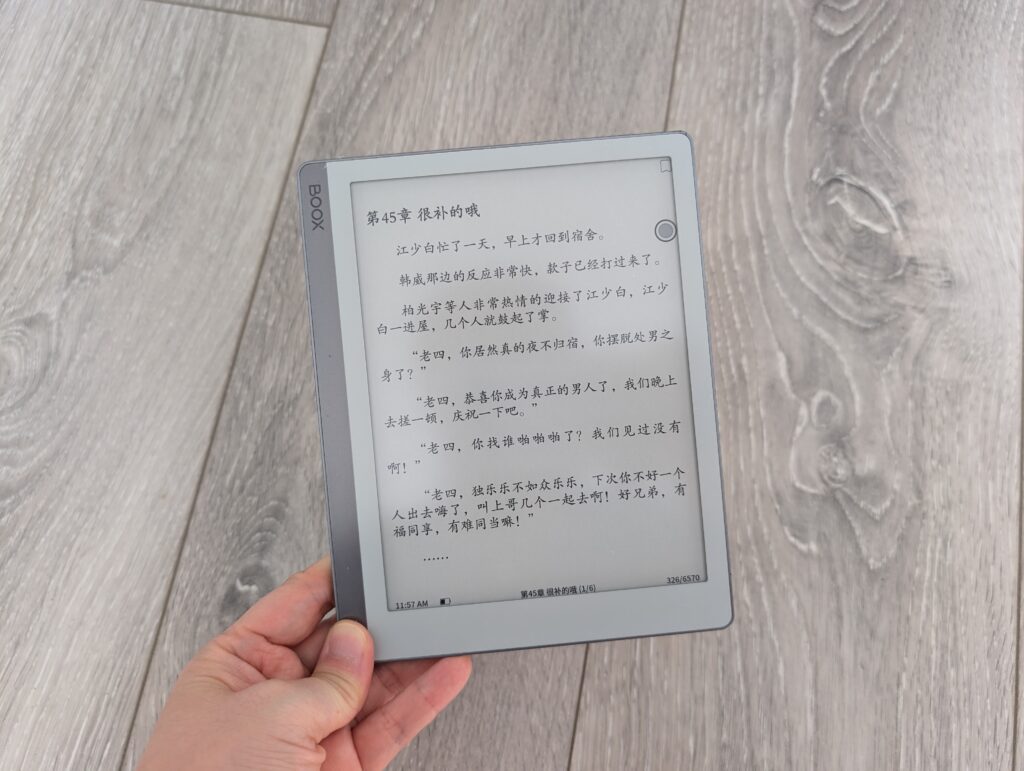
Reading on your mobile device or tablet is perfect for on the go. Here are two recommendations for reading apps for Chinese:
- Readibu is an amazing free app that can pull text from web pages into a reader mode with a Chinese-English pop-up dictionary.
- The paid document reader on Pleco is a great option for reading documents! The pop-up dictionary in the reader gives you access to all your Pleco dictionaries and human audio. This document reader pairs very well with the flashcard system, as you can add words straight from the pop-up dictionary to your review list. The downside is that you’ll need to source an offline version of your reading material in an .epub or .txt format.
Extra Tips
New word limit
Don’t go crazy and add every new word you come across to your review list; you will quickly become overwhelmed by the number of daily reviews!
In fact, you will learn many words through repeatedly encountering them through immersion and content consumption. As mentioned before, this is a natural form of a spaced repetition system.
Reviewing words, using apps or a manual system, is an additional aid to give you that little bit of a boost. So, don’t stress too much about the number of words you should be reviewing each day!
I recommend starting with 5 new words a day and increasing that when you feel more comfortable.
Routine Suggestion
If your schedule allows, you should read, review words and consume Chinese media daily. You don’t need to spend 6-8 hours a day. Just a little each day will be more effective than a lot at once.
Here’s a suggestion on how you can organise your time:
- Morning
- Review your words using your chosen SRS app.
- Spend no more than 20 minutes.
- If you find yourself spending too long on this, you can reduce the number of words you add to your review list or stop adding new words for a while.
- Afternoon
- Read for 30-40 minutes.
- Note down some unknown words, and add a few to your review list.
- Remember to limit yourself and don’t add too many each day.
- Evening
- Relax to a few episodes of a TV show you enjoy!
Reading and Listening
Listening and reading at the same time is an amazing way for you, as a heritage speaker, to improve your literacy skills very quickly. Many eBook and webnovels platforms, such as 微信读书, offer superb AI text-to-speech and high-quality human audiobooks with matching text.
But before you jump into the deep end and download 微信读书, remember that the vocabulary used in everyday conversation is only a small subset of the vocabulary you’ll find in literature. You could become very overwhelmed by the amount of unknown words and expressions.
This technique is extremely useful when your comprehension of the content is quite high (i.e., you can understand 98% and are able to guess the remaining 2%). If you want to adopt this technique, be mindful of the content you choose and avoid content that is far beyond your level.
Connecting with others
Being part of a community and connecting with others in the same situation as you is the best way to stay motivated.
It’s also a great way to feel accountable as you grow with others. Someday you’ll even be able to share your experience and guide others on their journey.
I encourage you to join the 看剧学汉语 Discord community, a tight-knit group of Mandarin learners. We also have a dedicated channel for heritage speakers where you can find information, pick up tips, and share experiences.
Final Words
Good luck, and don’t give up! There are going to be plenty of ups and downs, but there is a light at the end of this tunnel.
I have been on this journey for over four years, and it has been brilliant!
It has opened doors to things I never imagined, including texting my parents in Chinese and reading the same book as my mum.
Along the way, I’ve met and made friends with people all around the world. We may never meet in real life but we sure will be friends for many years to come. Sharing the same interests and going on the same journey together is an experience I will never forget!
Starting this blog, where I share my experiences and views on Chinese TV shows and books with you and other learners, is definitely something I never expected.
My Chinese cooking skills have massively improved due to all the Chinese YouTube cooking channels I’ve discovered!
These are all things I never imagined when I started this back in May 2020, and it all started from a dream of wanting to read Chinese books.
Reading will be the start of your journey, and believe me, four to five years from now, you’ll discover much more than the words on a page!